Why Acreage Homeowners Love Zero Turn Mowers for Faster Easier Lawn Care
A few acres can look beautiful on a Saturday morning, right up until the grass needs cutting. What feels like a quick yard job on a suburban block can turn into hours of circling trees, dodging sheds, trimming fence lines, and backing up around garden beds.
That is where a zero-turn mower earns its keep.
For acreage homeowners, the appeal is simple. A zero-turn mower can cut large areas faster, turn neatly around obstacles, and reduce the physical effort that comes with mowing week after week. It does not make the grass stop growing, of course, but it can make the job feel far less demanding.

Why zero-turn mowers suit acreage properties so well
Acreage mowing is different from mowing a compact backyard. There is more ground to cover, but that is only part of the challenge.
Large properties often include:
Long fence runs
Wide open grassed areas
Trees and orchard rows
Water tanks, sheds, and driveways
Uneven patches and mixed grass growth
Garden beds, paths, and gates
A standard ride-on mower can handle some of this, but it often needs more reversing, wider turns, and extra passes. A zero-turn mower uses independent drive wheels, which allow it to pivot sharply. That tight turning ability is the main reason people notice such a difference.
Instead of swinging wide around a tree, you can turn closely and keep moving. Instead of backing up repeatedly near a fence corner, you can manoeuvre with more control. Over a whole property, those little saved moments add up.
For larger lawns, speed and turning efficiency matter together. A mower that travels fast but handles poorly still wastes time. A mower that turns well but lacks deck width may still take too many passes. The right zero-turn mower brings both together in a practical way.
The biggest benefit is getting your weekend back
Most acreage owners do not mind mowing when conditions are good. Fresh air, a clean cut, and a tidy property can be satisfying. The problem comes when mowing eats half the weekend, then needs doing again the next week.
A zero-turn mower helps by reducing time in several ways.
It cuts down on repeated passes
Because zero-turn mowers are easy to line up at the end of each run, they make it simpler to keep a consistent mowing pattern. Cleaner lines mean fewer missed strips and less time going back over the same patch.
It handles obstacles without constant stopping
Trees, posts, clotheslines, garden edges, and water tanks all slow mowing down. With a standard mower, each obstacle often means braking, turning wide, reversing, and correcting. A zero-turn mower can move around these areas with less fuss.
It makes large open areas feel manageable
On open grass, a zero-turn mower can cover ground smoothly and keep a steady rhythm. For acreage homeowners with a few paddock-style lawn areas, this is one of the biggest day-to-day advantages.
The real value is not just a shorter mowing time. It is finishing the job with enough energy left to enjoy the property.
That matters. A beautiful acreage should be a place to live, relax, work on projects, and spend time with family. Lawn care should support that, not take over every spare hour.
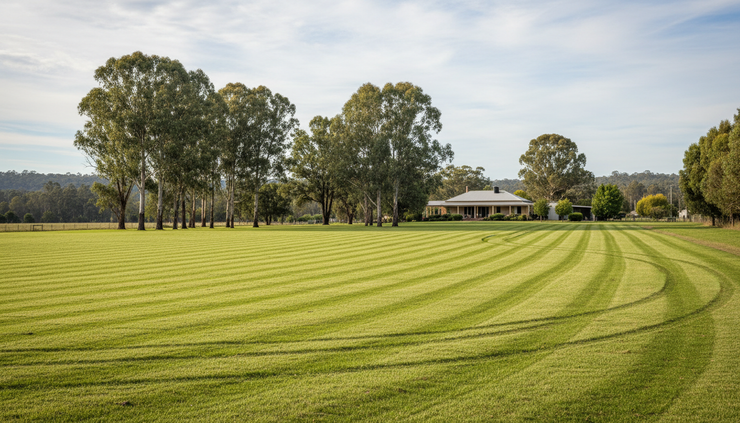
Easier mowing also means less physical strain
Acreage mowing can be tiring. Long sessions on bumpy ground, repeated steering corrections, and constant trimming afterwards can wear anyone down.
Zero-turn mowers help reduce that strain in a few key ways.
Less steering effort
Instead of using a steering wheel, most zero-turn mowers use lap bars. Once you get used to the controls, the machine responds quickly and smoothly. Many owners find this less tiring during long mowing sessions.
Fewer awkward manoeuvres
Backing up and turning repeatedly can be hard on the shoulders, back, and neck. A tighter turning radius helps reduce those stop-start movements.
Less follow-up trimming
No mower removes trimming entirely, but a zero-turn can get closer to posts, trees, borders, and edges than many traditional ride-ons. That can mean less time with a line trimmer after mowing.
A more comfortable pace
When a mower feels easier to control, the whole job feels calmer. You can slow down around delicate areas, pick up speed on open sections, and settle into a rhythm that suits the property.
This is especially useful for mixed acreage blocks where the mower needs to move between the front lawn, side access, paddock edges, and tighter backyard spaces.
What acreage owners tend to notice first
Many people buy a zero-turn mower expecting speed. They often end up appreciating the control just as much.
Here are a few common stories from acreage homeowners. These are composite examples based on the types of feedback owners often share, rather than quotes from one specific person.
The family with a growing weekend list
One family on a semi-rural block had been using a standard ride-on mower for years. Their mowing job often stretched across most of Saturday, especially when the grass was thick after rain.
After changing to a zero-turn mower, the biggest change was the flow of the job. They could move around trees and garden beds without constantly reversing. They still had to mow regularly, but the task no longer felt like the main event of the weekend.
Their takeaway was simple. The mower made the property feel easier to manage.
The owner who struggled with too much trimming
Another acreage owner had a house yard with sheds, fruit trees, fence posts, and a long driveway edge. The mowing itself was not the problem. The trimming afterwards made the job drag on.
With a zero-turn mower, they could cut closer around fixed obstacles and reduce the amount of hand-held trimming. That did not remove the need for detail work, but it made the whole routine quicker.
The couple maintaining a mixed-use block
A couple with an open lawn near the house and rougher outer areas wanted a mower that could handle both neat presentation and practical maintenance. For them, the zero-turn design made it easier to swap between careful mowing near gardens and faster cutting across open grass.
They liked that the mower felt purposeful, not oversized for the house yard and not underdone for the bigger sections.

How to choose the right zero-turn mower for your block
Acreage blocks vary a lot. One property may have smooth open lawns, while the next has slopes, trees, sandy patches, or narrow gates. The best mower depends on how the land is laid out.
Think about these practical points before choosing.
Feature to check | Why it matters on acreage |
Cutting deck width | A wider deck covers open grass faster, but it still needs to fit through gates and between obstacles. |
Engine power | Thicker grass and larger areas call for steady power, especially in warm growing seasons. |
Seat comfort | Long mowing sessions feel much better with a supportive seat and a stable ride. |
Build quality | Acreage mowing can be harder on frames, decks, tyres, and blades than small yard work. |
Service access | Easy access to filters, belts, blades, and grease points makes regular care simpler. |
A model such as the Gravely ZT XL 42" can suit homeowners who want a serious residential zero-turn mower but still need a size that works around tighter spaces. The key is matching the mower to the block, not just choosing the largest machine available.
For many properties, deck size becomes the main balancing act. Bigger decks save time in open areas, but smaller decks can be easier near gates, gardens, and sheds. If your property has both, measure the narrow points before making a decision.
Also look closely at terrain. Zero-turn mowers work best when used sensibly on suitable ground. On slopes, wet grass, loose soil, or rough patches, slow down and follow the manufacturer’s safety guidance. Good mowing is fast when conditions allow, and careful when the ground calls for respect.
Zero Turn Mowing makes routine lawn care more predictable
One reason acreage homeowners enjoy Zero Turn Mowing is that it turns a big job into a repeatable routine. Once you learn the machine and map your mowing pattern, the work becomes easier to plan.
A simple mowing routine may look like this:
Walk the lawn and clear branches, toys, hoses, and rocks.
Mow the open areas first while visibility is clear.
Work around trees, garden beds, and sheds.
Cut along fence lines and driveway edges.
Trim the small sections the mower cannot reach.
Blow clippings from paths, patios, and shed entries.
After a few cuts, the route becomes second nature. You learn which areas dry out first, which sections grow fastest, and where turning points work best. That knowledge saves time every time you mow.
It also helps with lawn presentation. A consistent pattern reduces missed strips and heavy overlaps. Changing direction from time to time can also help prevent wheel marks from forming in the same spots.
Maintenance tips that keep a zero-turn mower working well
A zero-turn mower is a hardworking machine. A little regular care helps it cut better, last longer, and feel safer to use.
Check the blades regularly
Sharp blades make a cleaner cut. Dull blades tear grass, which can leave the lawn looking pale or ragged. On acreage blocks, blades can wear faster because they may hit sticks, sandy soil, hidden roots, or small stones.
Check blades for:
Dull edges
Bends or cracks
Heavy nicks
Uneven wear
Replace damaged blades rather than trying to push on with a poor cut.
Clean the cutting deck
Grass clippings can build up under the deck, especially when mowing damp grass. That build-up affects airflow and cutting quality.
After mowing, let the machine cool, follow the safety instructions, and clean out packed clippings. A clean deck helps the mower discharge evenly and reduces strain on the machine.
Keep tyres at the right pressure
Uneven tyre pressure can lead to an uneven cut. It can also affect handling. Check tyre pressure often, especially if the mower sits for long periods between uses.
Change oil and filters as scheduled
Follow the service schedule in the owner’s manual. Oil, air filters, fuel filters, and spark plugs all play a part in reliable running. Dusty acreage conditions can make air filter checks especially important.
Inspect belts and moving parts
Belts, pulleys, and linkages work hard during mowing. Look for cracks, fraying, looseness, or unusual noise. Fixing a small issue early is much easier than dealing with a breakdown halfway through a cut.
Store it properly
When possible, keep the mower under cover. Sun, rain, and dust can shorten the life of seats, controls, electrical parts, and paint. A shed or covered bay is ideal.

A few habits make every mow smoother
Even with the right mower, technique matters. Good habits protect the machine and improve the result.
Mow when the grass is dry if you can. Wet grass clumps, sticks under the deck, and can make slopes slippery.
Avoid cutting too low. Scalping stresses the lawn and can expose soil. A slightly higher cut often suits Australian conditions, especially during hot or dry periods.
Slow down in thick grass. A steady pace gives the blades time to cut cleanly and helps prevent clumping.
Vary your pattern. Changing direction helps the lawn stand up better and avoids creating the same wheel tracks.
Keep an eye on the weather. After heavy rain, soft ground can rut under the mower. Waiting a day or two may save repairs to the lawn.
These small choices make mowing easier and help the property look better between cuts.
Why the right mower changes how a property feels
Acreage living comes with space, privacy, and room to do more outdoors. It also comes with ongoing maintenance. Grass keeps growing, branches fall, weeds appear, and edges need attention.
A zero-turn mower does not remove property care, but it can make one of the biggest recurring jobs much easier. That changes how the whole block feels.
When mowing takes less time, it becomes easier to keep up. When the mower handles well, the job feels less frustrating. When the result looks tidy, the property feels more welcoming.
For many homeowners, that is the real reason they love zero-turn mowers. The machine helps them stay ahead of the grass instead of always chasing it.
If you already use a zero-turn mower on an acreage block, share what has worked for you. Other homeowners often learn the most from real mowing routes, maintenance habits, and lessons picked up over a few seasons.
A large lawn should feel like part of the reward of acreage living. With the right zero-turn mower and a simple care routine, it can be faster to maintain, easier to enjoy, and far less likely to take over the weekend.


Comments